Evelyn's Christmas party
American PsychoEvelyn's Christmas party is a decisive episode in which elite sociability becomes a stage for fractured perception, competitive display, and concealed violence. Patrick Bateman enters a crowded brownstone after drinking with Charles Murphy and committing a killing on the way, then moves through the celebration as though its decorations, servants, guests, and vehicles were props in a performance he can no longer reliably interpret. The party's festive surface remains intact for everyone except him, making the scene a concentrated study in the gap between social appearance and Bateman's unstable reality.
Causes and Background
The party takes place during the Christmas season at Evelyn Richards's brownstone, a setting already associated with the privileged social world that Bateman and his companions inhabit. Before arriving, Bateman drinks at Rusty's with Charles Murphy, whose tirade about Japanese ownership of the Empire State Building and Nell's unsettles him. After leaving the bar, Bateman attacks and kills a Japanese delivery boy in a doorway, then approaches Evelyn's neighborhood while the police lines remain around the neighboring brownstone where Victoria Bell has been decapitated. The party therefore begins under the sign of recent violence, even though its guests are preparing for champagne, elaborate food, and seasonal ceremony.
Bateman is also late and psychologically strained. The party follows an episode in which he has taken Halcion without achieving sleep and has described an existential emptiness connected, perhaps, to the way he treated Evelyn Richards. His preparation is inseparable from the culture of surfaces that governs his world: clothing, alcohol, food, service, and access all function as visible credentials. The contrast between his carefully maintained appearance and the violence preceding his arrival gives the gathering its central tension.
Setting and Social Performance
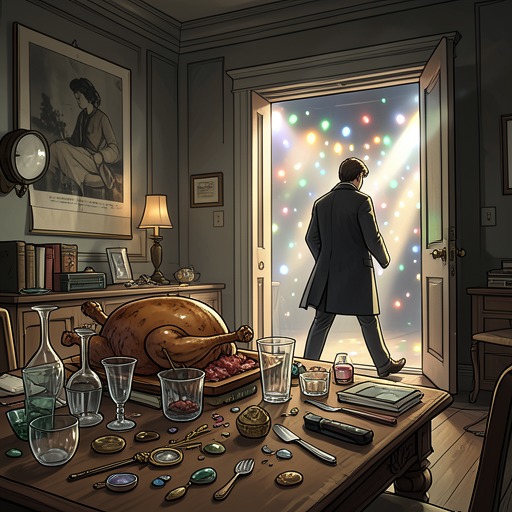
The brownstone is presented as an extravagant display of hospitality. Two tall blue spruces covered with white lights flank the fireplace, old songs by the Ronettes play on the CD player, and a bartender serves champagne, eggnog, Manhattans, martinis, Calera Jensen pinot noir, Chappellet chardonnay, and twenty-year-old ports. A long table carries an almost theatrical catalogue of luxury food, including Beluga caviar, lobster and oyster bisques, roast goose, roast duck, veal, partridge, truffles, souffles, and several elaborate desserts. Sterling silver Tiffany candleholders complete the arrangement.
The guests participate in the same economy of display. Donald Petersen wears paper antlers, Maria and Darwin Hutton's five-year-old daughter Cassandra wears a seven-hundred-dollar velvet dress and petticoat by Nancy Halser, and Evelyn Richards appears in a sable jacket and Ralph Lauren velvet pants. The party's objects announce rank more loudly than conversation does. Its abundance is not merely nourishment but a public demonstration of taste, wealth, and effortless access.
That performance depends on shared recognition. At another social gathering, Bateman's new business card and David Van Patten's superior card turn professional identity into a contest of color, type, and manufacture; at Evelyn Richards's party, the same competitive logic expands into clothing, alcohol, decorations, and service. The social world remains legible only so long as everyone agrees to read its signs in the same way. Bateman's misreadings show how quickly that agreement can fail.
Misrecognition and the Breakdown of the Party
Bateman's perception begins to diverge from the other guests' almost immediately. He sees small figures in green and red elf suits carrying trays of appetizers, while also acknowledging that he may be hallucinating. After drinking champagne and double Absolut martinis, he continues to see them. When Evelyn Richards approaches with mistletoe and a candy cane, she kisses him and wishes him a merry Christmas, but Bateman's attention remains fixed on the figures moving through the room.
He then asks why Laurence Tisch is passing around canapes. Evelyn Richards corrects him, explaining that the figure is one of the Christmas elves, not Laurence Tisch. Bateman insists on calling the figures midgets, while Evelyn Richards names them as Santa's helpers and identifies them as Rudolph, Blitzen, and Donner. Her affectionate interpretation restores the party's festive logic for herself, but not for Bateman. The exchange turns a harmless decoration into evidence of his isolation: the same visual object produces warmth and amusement for Evelyn Richards and confusion, irritation, and suspicion for Bateman.
Bateman responds by trying to remove Evelyn Richards from the scene. He worries about the party's supervision, proposes choosing an elf as an overseer, and pulls her toward the back door. In the alley, he checks whether familiar people are entering or leaving before moving toward a limousine he thinks belongs to Paul Owen. His caution suggests that escape is not spontaneous; it is another controlled maneuver designed to conceal what he is doing and to preserve his authority over Evelyn Richards.
The Wrong Limousine and Escape
Bateman pushes Evelyn Richards into the nearest limousine without confirming its ownership. When he speaks to the driver, he presents himself as Pat Bateman and identifies Paul Owen as the customer, but the driver explains that the vehicle belongs to Mr. Barker. Evelyn Richards, meanwhile, treats the mistake as an exciting act of privilege. She emerges holding a bottle of Cristal and a gold box of truffles, pleased by the champagne and the apparent secrecy of the departure.
Bateman recognizes the danger only when it is too late. He pulls Evelyn Richards from the wrong vehicle, tells her to take the truffles, and moves her into another limousine whose driver looks exactly like the first. The repeated drivers intensify the uncertainty surrounding identity and recognition. Bateman again offers a distorted version of his name, then pays two hundred dollars when asked where he wants to go and orders the driver to take them to Club Chernoble.
The escape preserves the appearance of a glamorous night out while exposing its mechanical emptiness. A limousine, a bottle of Cristal, truffles, a designer wardrobe, and a nightclub destination make the episode look like ordinary elite consumption. Yet the vehicle is initially misidentified, the passenger is physically pushed into it, and the destination follows a frantic retreat from a party Bateman can no longer tolerate. The symbols of control become instruments of confusion.
Consequences and Narrative Significance
Evelyn's Christmas party does not resolve Bateman's instability; it displays it in public without making it fully visible to the surrounding society. Evelyn Richards continues to interpret his actions as playful and naughty, while Bateman experiences the gathering as an environment filled with hallucinated figures, mistaken identities, and an urgent need to flee. The party's social rituals thus absorb his abnormality rather than exposing it. A kiss, a martini, mistletoe, and a limousine can make coercion appear romantic and disorientation appear mischievous.
The event also extends the novel's recurring contrast between immaculate surfaces and hidden damage. Bateman's evening includes designer clothing, expensive drinks, seasonal music, and an ornamental feast, but it is framed by the killing of the delivery boy and by the police presence at the neighboring brownstone. The festive house does not stand apart from violence; it sits beside it, continues despite it, and provides a polished language in which violence can disappear.
In narrative terms, the party is especially important because it makes Bateman's unreliable narration concrete through a shared social scene. His account does not simply describe an unusual party; it makes the reader occupy the unstable interval between what Bateman sees and what Evelyn Richards says is actually there. The result is neither a secure supernatural explanation nor a stable realistic one. The party remains a spectacle of status and celebration, but its deepest function is to reveal that Bateman's carefully managed public identity can continue operating even as perception, judgment, and moral boundaries have begun to collapse.